
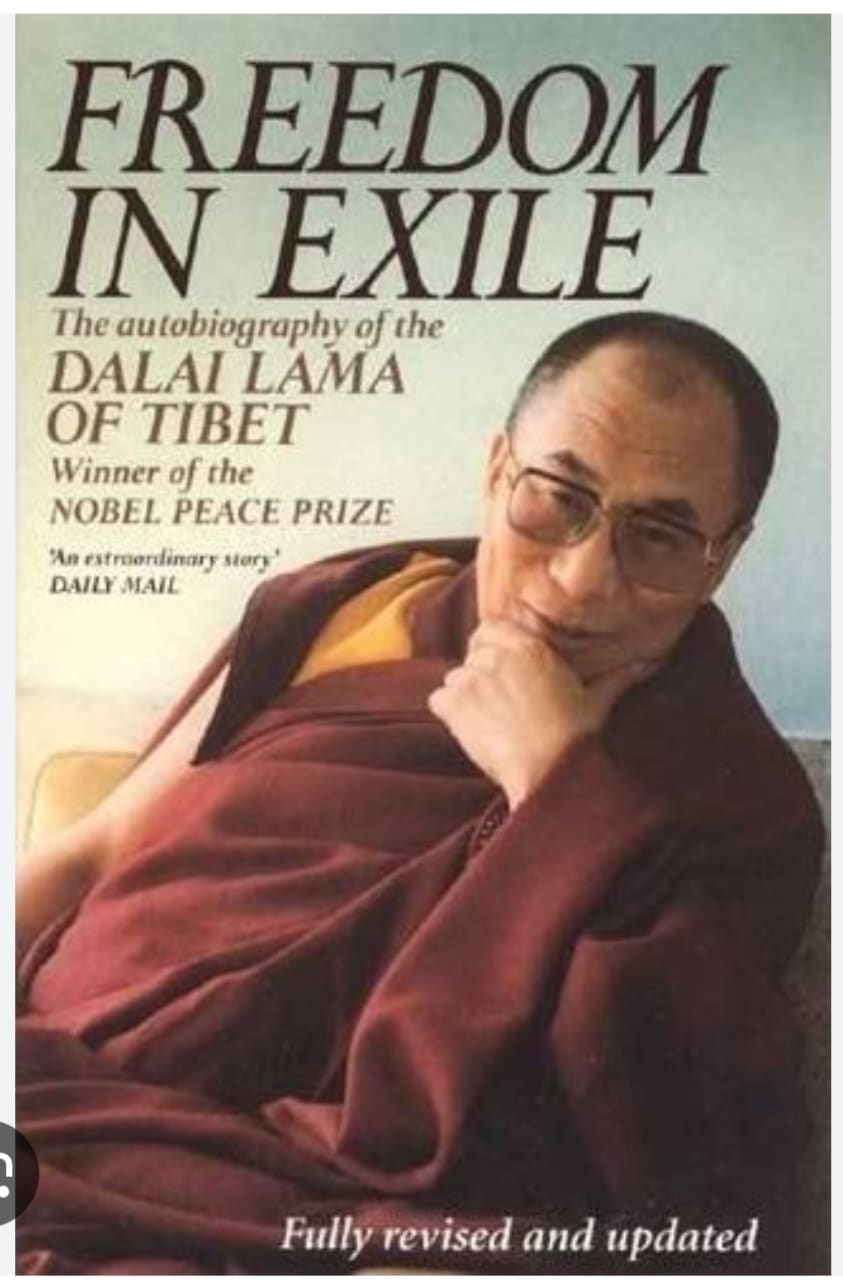

Freedom in Exile is a captivating memoir written by His Holiness, The 14th Dalai Lama, Tenzin Gyatso. It was released in 1991. Spanning his life from childhood to his exile in India, the book provides a deep personal account of his experiences and insights as the spiritual leader of Tibet and his relentless pursuit of freedom for his people.
The book describes how a two year old boy was recognised through a traditional process of discovery as being the reincarnation of all previous Dalai Lamas, the spiritual rulers of Tibet. Taken away from his parents, he was then brought up in Lhasa according to a monastic regimen of rigorous austerity and in almost total isolation.
At the age of seven he was enthroned in the 1000-room Potala palace as the supreme spiritual leader of a nation, the size of Western Europe, with population of six million. He then became the head of the state when he was just fifteen.
In this astonishingly frank autobiography, The Dalai Lama reveals the remarkable inner strength that allowed him to master both the mysteries of Tibetan Buddhism and the brutal realities of Chinese Communism.
In an unassuming and down-to-earth style, he writes about what it means to be the living reincarnation of the Dalai Lama and the religious and secular head of Tibet. He also delicately pens the amusing stories of his childhood and his upbringing in Lhasa.
The Dalai Lama discusses about the 1959 Chinese invasion of Tibet. The long years of torture and the years he spent caring for his fellow Tibetan refugees to promote world peace. He also talks about his decision to move the Tibetan government to Dharamsala in India, The removal was done at night, and the government in exile remains in Dharamsala to this day.
The title “Freedom in Exile” refers to the freedom that India offers to him.
The Dalai Lama’s autobiography fills our heart with tremendous respect and admiration for this gentle, humble and compassionate man and spiritual leader.
It also teaches us about patience and forgiveness around the things we can’t control. It also makes us aware about the people who were lost and the culture that struggles to persist following the occupation of Tibet.
Would definitely recommend it to people who would like to know more about Tibet, Buddhism and The Dalai Lama.
©️Sheetal Pradhan Deshpande